Sale
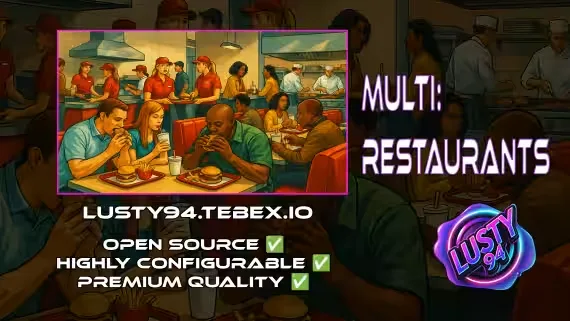
All in One Modular Restaurant Jobs
$20.00
$15.00
Fourteen restaurant jobs preconfigured, from Burgershot to Bean Machine
Lifetime updates

Lusty makes FiveM restaurant scripts, sold through Tebex and mirrored here. The current lineup is a single modular jobs resource that handles cafes, fast food chains and restaurants from one install, and it runs on ESX, QBCore and Qbox out of the box.
Lusty writes FiveM scripts for one very specific corner of the map: the food side of the city. If your server keeps opening burger joints that die two weeks in because the job is a stove prop and a payslip, this is the studio to look at. The work is built for owners who want a real restaurant loop without wiring together five separate resources.
The catalog is small on purpose. One resource does the whole category, and it is written so a server can run a coffee cart, a fast food chain and a fine dining spot off the same code. That keeps resmon predictable and keeps your kitchen jobs behaving the same way across every location, which matters when players hop between them.
The headline product is All in One Modular Restaurant Jobs. The name is the pitch. Instead of buying a separate script for the diner, another for the pizza place and a third for the coffee shop, you configure new jobs from one base. Each location gets its own menu, its own prep steps and its own economy, so a taco stand does not feel like a sushi bar with a reskin.
The style leans practical over flashy. Menus are set in config, recipes chain ingredients into finished dishes, and the front-of-house side gives staff a way to actually take an order and hand food to a customer rather than spawning a burger from thin air. Owners get a job that reads as work: prep, cook, serve, clean up, repeat, with pay tied to what actually leaves the pass.
Because it is modular, it scales with the server. Small cities can ship it with one restaurant enabled and grow into the rest. Bigger economies can spin up half a dozen branded chains from the same resource and let players pick where they want to grind. There is one file to update when Lusty pushes a fix, not five.
Lusty supports the three frameworks most FiveM servers actually run:
Installs are drag-and-drop. Pull the zip from your account, drop the folder into resources, add it to your server.cfg, and open config.lua to switch on the restaurants you want. Menus, prices, prep times, delivery points and job grades all live in config, so you can tune the loop for your economy without touching the core code.
It plays nicely with the standard toolkit most servers already have running: an ox_lib style menu layer, whichever inventory your framework ships with, and target scripts for the counter and kitchen interactions. Because the ingredient system is config-driven, hooking it into your existing farming, delivery or supplier jobs is a matter of matching item names rather than rewriting the resource.
If you are migrating from a pile of one-off restaurant scripts, the win is that one resource replaces the lot. That usually means fewer conflicts on menu items, fewer duplicate job grades in the framework, and one changelog to track instead of five stale forum threads.
Buying through this store gets you the same file Lusty ships on Tebex, with an account that keeps every purchase and update in one place. Invoices sit next to the rest of your server stack, so renewals, VAT and receipts are easy to hand to whoever pays for the community.
The short version: if your restaurant scene is currently three broken scripts and a debug menu, Lusty's modular jobs resource is the one to try first. It is one install, one config file, one style of gameplay across every food spot on the map, and it works on the framework you are already on.
Lusty focuses on restaurant and food-service scripts. The current catalog is a single modular jobs resource that covers cafes, fast food chains and full restaurants from one install, aimed at server owners who want a real cooking and serving loop instead of a stove prop tied to a payslip.
It runs on ESX, QBCore and Qbox out of the box. You pick the framework in the config, and the job grades, payments and inventory calls hook into whichever one your server is already using.
Yes, that is the point of the modular design. You enable each restaurant in the config and give it its own menu, prep steps and pricing, so a coffee cart, a burger chain and a sit-down spot can all run off the same script without conflicting.
Download the zip from your account, drop the folder into your server's resources directory and add it to server.cfg. Open config.lua to switch on the restaurants you want and set menus, prices and job grades. No database schema wrangling beyond adding items your framework does not already have.
Lusty's resource is built for the standard FiveM stack, so it works with the inventory your framework ships and with common target scripts on counters and stoves. If you use a custom inventory, match the item names in the config to what already exists in your database.
Lusty distributes through Tebex, so the code follows whatever protection was set on the Tebex listing. Config, menus and item lists are exposed so you can tune the economy and shop layout without touching the core logic.
You get the same file, delivered instantly, tied to an account that keeps all your FiveM purchases and invoices together. Updates published by Lusty come through the same account, so you do not have to hunt across multiple stores when a new version drops.