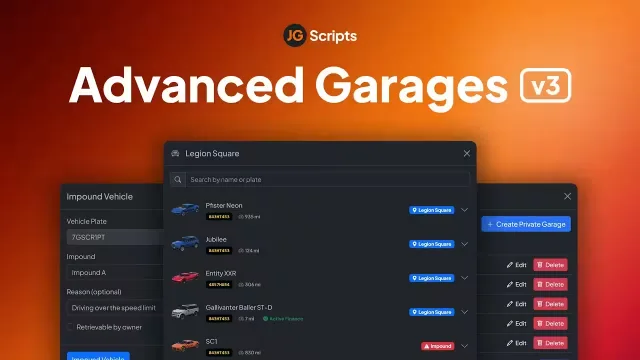
JG Advanced Garages V3
$20.00
Public, job, gang and private garages with walk-in interiors
Lifetime updates
Garage and vehicle key scripts decide whether cars on your server persist properly or vanish into the database. This collection covers player garages, impound systems and key handling for ESX, QBCore and Qbox, most of it built to replace stock qb-garages and qb-vehiclekeys outright. Pick the pair that matches your inventory and target setup, and stop fielding lost car tickets.
Public, job, gang and private garages with walk-in interiors

Ten drop-in garage shells for player owned parking spots
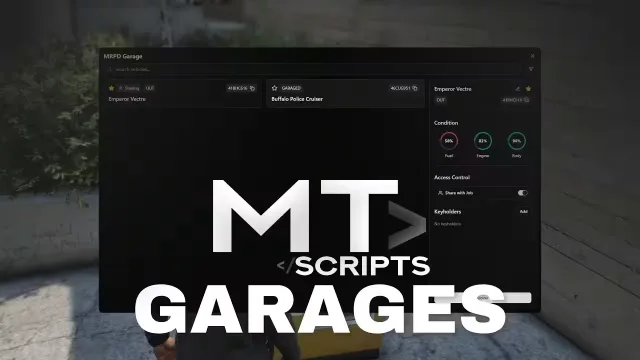
Cars stay where you parked them, in the condition you left them
Walk away and your car locks itself, lights and all
Every player on your server parks a car within the first ten minutes, and that is when they meet your garage script. If it double spawns vehicles, loses a stored car after a restart, or lets someone drive off in a car they never owned, they notice before they notice anything else. Garage and vehicle key scripts are infrastructure, not content, so the bar is reliability first and features second.
This category collects the two halves of vehicle ownership. Garage scripts handle storing, retrieving and impounding cars. Key scripts decide who can actually start the engine. Some resources here bundle both, others are standalone replacements for qb-garages or qb-vehiclekeys that slot into an existing setup. You will find player garages, job garages for police and EMS fleets, gang garages, public parking, depot and impound systems, plus key handling with lockpicks, hotwiring, key items and key transfers.
The defaults that ship with QBCore and ESX work, but they are thin. Stock qb-garages is a static list of blips and a menu. The scripts here add things like parking a car in any garage rather than the one it came from, per-garage vehicle classes so boats and helicopters store where they should, damage and fuel persistence, and shared garages for crews. On the key side, the difference between a stock setup and a proper key script is whether keys survive a relog, whether a stolen car stays stolen after a restart, and whether police get a dispatch alert when someone starts raking a lock.
Almost everything in this category ships with framework bridges for ESX, QBCore and Qbox, and each listing states exactly which. Key scripts usually depend on ox_lib for menus and notifications, and the item-based ones need ox_inventory or qb-inventory for metadata keys. Garage scripts read your existing owned_vehicles or player_vehicles table rather than creating their own, so migrating from the stock garage rarely needs more than a column check. Most sellers document the mapping for the garage, state and fuel columns.
Installation is the usual drag-and-drop into your resources folder, a config pass, and an ensure line in server.cfg. Escrow protected scripts keep the config open while locking core logic. Open source versions cost more up front but let you rewrite spawn logic or hook your own dispatch and MDT. If you run a custom framework fork, buy open source, because bridge files are exactly where forks break.
Every script listed here states its framework support, its dependencies and whether it is escrow or open source, so you know what you are getting before checkout. Purchases include updates, and support runs through the store rather than a Discord ticket that dies in a queue. If a garage and a key script are known to conflict, the listing says so. Vehicle ownership is the one system you cannot afford to break on a live server, and the point of this collection is that you do not have to test five abandoned GitHub forks to find one that holds up.
Yes, most garage and key scripts here are direct replacements. They read the same player_vehicles table and expose similar exports, so other resources that check for keys keep working. Each listing names the resources it replaces and any exports you may need to update.
Most ship with bridges for ESX, QBCore and Qbox, and every listing states exactly which frameworks are supported. ESX versions read owned_vehicles while QBCore versions read player_vehicles. If you run a heavily modified fork, choose an open source version so you can adjust the bridge yourself.
With the item-based key scripts, yes. Keys are stored as inventory items with metadata in ox_inventory or qb-inventory, so they persist like any other item, sit in stashes and can be handed to other players. Scripts that only track keys in memory lose them on restart, and listings flag which method a script uses.
In almost all cases, yes. These scripts read your existing vehicle table rather than creating a new one, so stored cars appear in the new garage after a config pass to map column names. Back up your database first anyway, since state values sometimes differ between scripts.
Both exist in this category and every listing says which. Escrow versions keep the config open while protecting core files, which is enough for most setups. Open source versions cost more but let you modify spawn logic, dispatch hooks and framework bridges, which matters on custom forks.
0.00ms idle is the standard for anything current. Garage and key scripts built on ox_target or qb-target only run code when a player interacts, so there is no reason for a constant tick. If a script idles higher, it is running distance loops and belongs in an older era.